
Views: 0 Author: Site Editor Publish Time: 2026-10-08 Origin: Site


A dinner plate that photographs beautifully can become a poor purchase if it crowds the table, catches on the dishwasher rack, or needs replacing in a collection that is difficult to reorder. Restaurant dinnerware connects the menu with the working conditions behind every service. The right choice must accommodate food, fit the dining room, and move efficiently through preparation, carrying, clearing, washing, and storage. Start with those requirements before selecting a material or color. A clear specification and a representative sample trial make the decision easier to defend than a catalog comparison based only on appearance and unit price.
Selection at a Glance: Map each menu item to a plate function, shortlist suitable bodies and finishes, measure equipment and table constraints, trial representative samples, and agree replenishment terms. Approve restaurant dinnerware only after the kitchen, service team, stewarding team, and purchasing team have checked the same proposed collection.
List the dishes that place different demands on dinnerware. Include sauced mains, foods cut at the table, shared dishes, salads, desserts, and any meals served on trays. The aim is to define functions rather than assign a different shape to every recipe. Several dishes can share one useful plate if their portions and service conditions are compatible.
A wide-rimmed plate and a coupe plate of equal diameter can offer different eating surfaces. Compare the central well, rim width, depth, and curvature. A plate with generous visual space may still leave too little room for a protein, side dish, and sauce without crowding.
Plate the normal serving rather than a specially styled sample portion. Check whether a knife stays inside the eating area and whether sauce remains contained when the plate is carried. For bowls, distinguish brimful capacity from a practical service fill. A nominal volume says little about space for garnish or resistance to spilling.
These checks also protect portion consistency. A shape that makes a standard meal look too sparse can create pressure to increase servings. An undersized piece can force cooks to stack ingredients or clean rims repeatedly. Restaurant dinnerware should support the portion specification you intend to deliver.
Trace its route from clean storage to the pass, dining table, clearing station, and wash area. Identify where pieces are stacked, slid, carried, or separated. This reveals constraints that a tabletop photograph misses: a narrow service aisle, a short shelf, a rack with awkward spacing, or a small tray.
Plan for menu changes too. A versatile base collection leaves room to add a signature piece later without replacing the entire program. If every dish depends on a unique plate, a stock shortage can quickly become a menu problem rather than a simple inventory issue.
Porcelain, stoneware, and bone china are all ceramic categories. Their names describe useful starting points, but the finished design determines much of their day-to-day suitability. Compare actual pieces with similar dimensions and intended applications rather than assuming that one material automatically wins every durability comparison.
Option | Useful qualities | Trade-off to assess | Purchasing question |
|---|---|---|---|
Porcelain | Dense body and broad design flexibility | Edge profile and finish can vary significantly | What commercial use and care information applies to this item? |
Stoneware | Substantial feel and expressive glazes | Weight and surface variation may affect service | How consistent are dimensions, finish, and stacking? |
Bone china | Refined appearance and potentially light profiles | Decoration may require specific care | Does the proposed collection fit the handling and washing routine? |
Glass | Distinctive transparency or colored presentation | Impact behavior and storage need assessment | Which use conditions are approved for the exact glass body? |
Break-resistant alternatives | Potential suitability where breakable ware is restricted | Heating and cleaning limits differ by material | Do the product's instructions match the intended service? |
Finish changes the comparison. A smooth surface, textured rim, matte glaze, or metallic decoration can alter cleaning, cutlery contact, and presentation. Test the surface where food and utensils actually touch. A decorative texture confined to the outer rim presents a different practical question from texture across the whole eating area.
Compare pale sauces, browned foods, dark desserts, and leafy ingredients under the dining room's real lighting. A color that complements one dish can obscure another. Photograph samples if online presentation matters, but do not approve restaurant dinnerware from photographs alone; glare and camera processing can change its appearance.
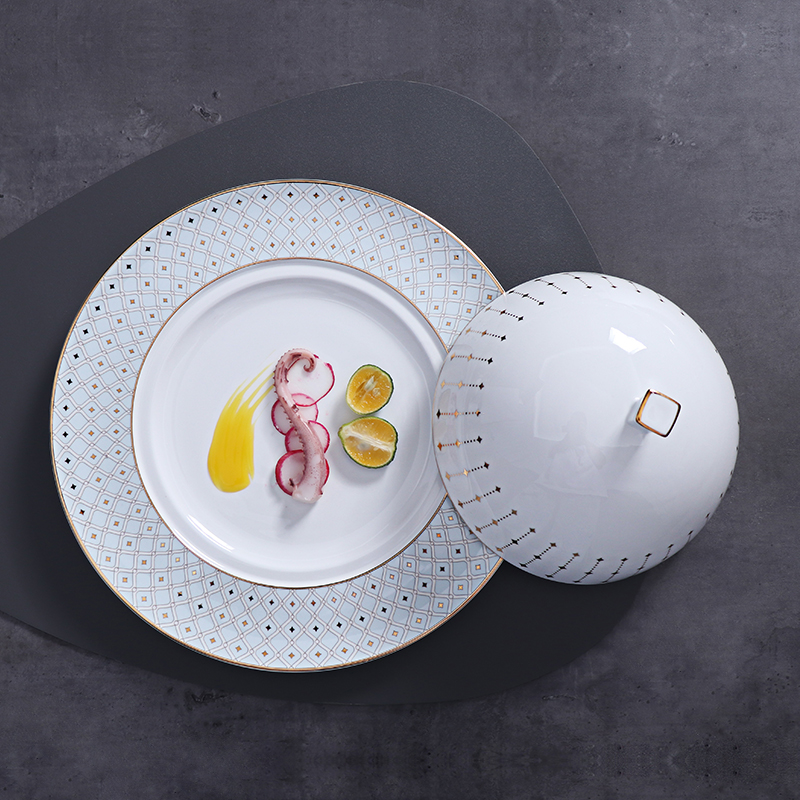
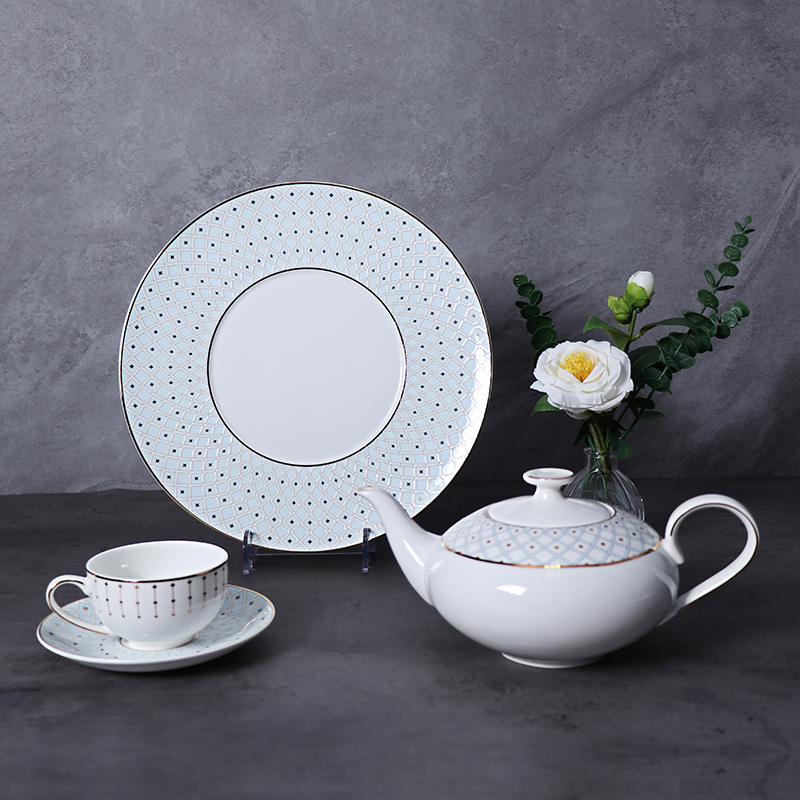
Rollin Porcelain's Blue Bone China Plates offer a light-blue design with gold-rim detailing. Such a combination can be assessed as an accent for a composed starter or dessert. It still needs the same practical checks as a plain collection, including finish-specific care and compatibility with the intended serving routine.
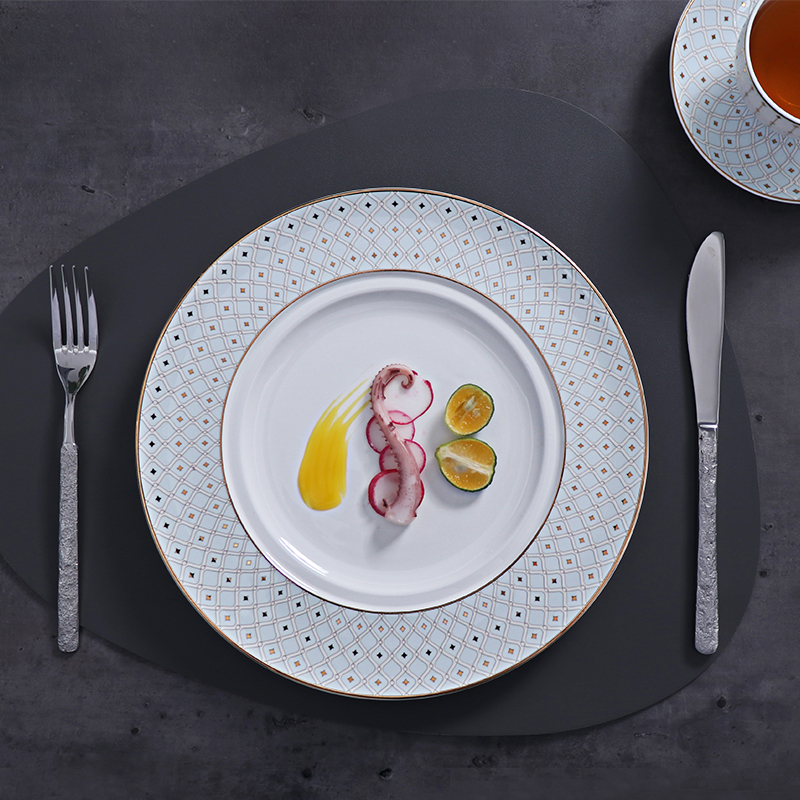
Do not infer restaurant endorsements or performance credentials from a decorative product name. Evaluate the piece on its own specifications and samples. Likewise, do not assume that gold-colored decoration permits microwave use; confirm the composition and instructions for the exact finish.
The kitchen and dining room should evaluate the same sample set. A chef may prefer a large dramatic plate while a server finds it difficult to carry alongside other dishes. A purchasing manager may favor a low price while stewarding discovers that the shape requires additional rack space. Resolving these differences early is less costly than changing a bulk order.
Plate weight alone is incomplete. Include food, bowls, beverage ware, and cutlery in the carrying exercise where relevant. Check grip, balance, and the space available for fingers. An attractive rim that is hard to hold comfortably can slow delivery or encourage staff to use an awkward carrying method.
Check the dining table with a full setting. Shared plates, glasses, menus, condiments, and personal items occupy space too. Oversized restaurant dinnerware can obstruct conversation or leave nowhere to put a side dish, even when the individual main course looks well proportioned.
Build a stack at the intended working height. Record total height and observe whether pieces lean, bind, or lift together. Count how many fit on a shelf without making access awkward. Do not equate a low individual plate profile with guaranteed storage efficiency; the way pieces nest determines the result.
Place samples in the normal wash racks and check clearances. Pieces should sit securely while allowing the intended washing process to reach relevant surfaces. Use the rack and machine instructions alongside the dinnerware instructions. A generic dishwasher-safe statement does not answer every loading or decorated-finish question.
Use a short form for rocking, glaze defects, handling, wash observations, and finish changes. Retain an unused reference sample for comparison. A short operational trial can identify obvious incompatibilities, but it cannot justify claims about years of service or a guaranteed breakage rate.
If an item must enter a warmer, oven, or microwave, describe the exact sequence and request confirmed limits. Do not run extreme temperature or destructive impact experiments as an informal kitchen test. Where such performance is essential, ask for appropriate product testing and documented suitability.
Restaurant dinnerware should be ordered by item and service role, not merely by boxed set. A retail-style set may include pieces the menu never uses while providing too few of the plates that circulate continuously. Confirm whether each required shape can be purchased and replaced individually.
At peak service, some pieces are on tables, some are waiting at the pass, some are being cleared or washed, and some are unavailable after damage. A seat count captures only part of that demand. Estimate the maximum quantity unavailable at one time for each important item.
Separate concurrent demand from total daily covers. A restaurant can serve several sittings with the same plates if turnaround is reliable. Conversely, a short, intense service may need substantial stock even with fewer daily covers. Avoid adopting one universal number of plates per seat for every restaurant dinnerware item.
Order detail | Information to specify | Reason |
|---|---|---|
Item identity | Shape reference, size, body, color, and decoration | Prevents substitutions between similar-looking items |
Quantities | Working stock and contingency by item | Aligns the order with actual circulation |
Acceptance | Reference samples and agreed tolerances | Provides a basis for inspecting deliveries |
Care | Washing and heating restrictions | Supports a consistent operating routine |
Replenishment | Minimum repeat quantity and expected supply terms | Reduces uncertainty after losses |
Packaging | Carton quantities and transit protection | Connects receiving, storage, and damage handling |
Compare purchase price, freight, replacement costs, storage demands, and any extra care work. Avoid assuming that a higher-priced plate will necessarily reduce breakage. Use comparable supplier information and, after opening, your own item-level loss records to refine the budget.
A simple purchasing scenario makes the trade-off visible. One plate might be cheaper but require a large minimum reorder; another might cost more individually but allow smaller replenishment orders. The better choice depends on cash flow, storage, and expected losses, not just the first invoice.
Ask what remains consistent across repeat batches and how discontinued items are handled. Keep an approved alternative for critical service roles. An alternative should match functional needs even if its appearance differs; document when it may be used so shortages do not trigger improvised table settings.
For customized restaurant dinnerware, agree artwork position, visible color references, setup charges, ownership of any tooling, and repeat-order conditions before committing. Confirm food-contact documentation for the destination and exact decoration. These are procurement checks, not reasons to make unsupported certification claims in the menu or marketing.
Finish the process with a receiving plan. Inspect quantities and condition before distributing stock, identify cartons by item, and keep damaged pieces out of active inventory. A carefully chosen collection can still disappoint if staff cannot locate replacements or distinguish similar sizes during a busy shift.
The best restaurant dinnerware for a particular venue is the collection that serves its menu, fits its equipment, and can be replenished on workable terms. Start with food and circulation, then evaluate material, shape, finish, and appearance through representative samples. Include service and stewarding teams before approving the order. Rollin Porcelain is a ceramic tableware manufacturer and supplier offering hospitality collections, including decorated bone china. A disciplined selection process helps buyers judge which proposed pieces support their restaurant's actual operating conditions while preserving a coherent presentation across daily service and future menu changes.
Confirm core functions early, but delay specialized shapes until representative dishes and portions are stable. If ordering deadlines require an earlier commitment, prioritize versatile pieces and clearly identify the assumptions behind their quantities and dimensions.
Yes. Use shared visual cues and document each item's service role. Check that different collections do not create incompatible stacks or confusing care instructions. Keep substitute rules clear so mixing remains intentional during stock shortages.
No. Stack efficiency depends on the underside, curvature, foot ring, and contact points. Compare physical stacks at your intended working height rather than selecting by the shape name alone.
Protect enough working stock for critical items, track depletion, and reorder before service becomes dependent on the last reserve carton. Agree an acceptable functional substitute in advance, particularly for shapes required by several menu items.
Logo size should suit the plate's role and the food presentation. Test actual artwork at serving scale. A discreet placement may remain visible without competing with the dish, while a central logo may disappear beneath food.
